

As an Amazon Associate I earn from qualifying purchases.

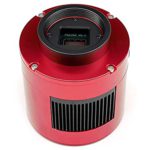
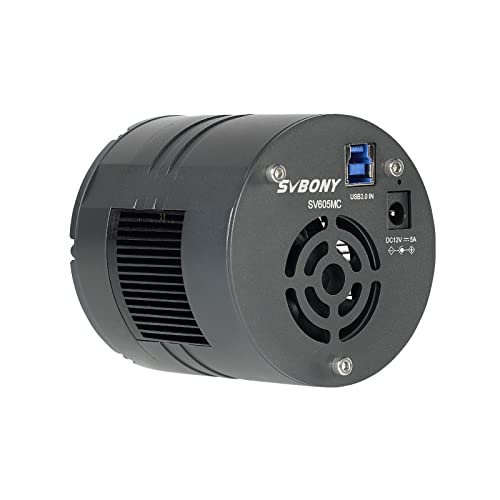
- SV605MC cooled camera suitable for deep sky photography users; enthusiasts who use narrow-band filters to shoot; deep sky photography; panoramic astronomy; meteor monitoring and lucky imaging
- IMX533 mono CMOS sensor incorporates 14 bit A/D converter; the 14-bit digital output makes it possible to readout the signals of 9.07M effective pixels at high-speed of 20 FPS
- SV605MC deep sky camera; read out noise is as low as 1.0e which makes sure the highly suitable for high definition; low noise deep space objects imaging
- Two-stage TEC cooling; the SV605MC cooled camera can lower the CMOS sensor temperature to 30 degrees Celsius below ambient temperature; which can greatly reduce dark current generation and sensor noise even during longer exposure times
- SV605MC cooled camera adopts starvis back-illuminated technology; the metal wiring layer of the sensor and the position of the diode are reversed; the light reaches the photodiode without obstruction; the absorption rate is higher; and the image quality is higher

Title: SVBONY SV605MC Cooled Camera: A Game-Changer for Deep Sky Astrophotography
Introduction:
Capturing stunning images of celestial objects in the night sky has always been a fascinating endeavor for astronomy enthusiasts. The SVBONY SV605MC Cooled Camera, equipped with a 9-megapixel CMOS sensor and advanced features, has revolutionized the field of deep sky astrophotography. In this review, we delve into the capabilities and advantages of this remarkable camera, exploring its various applications and the benefits it offers to photographers and astronomers alike.
Application 1: Deep Sky Photography
When it comes to capturing the intricate details of deep space objects, the SVBONY SV605MC Cooled Camera shines. With its IMX533 mono CMOS sensor and 14-bit A/D converter, this camera delivers exceptional image quality and clarity. The high-speed readout of 20 FPS allows for quick and efficient capture of deep sky objects, unveiling the beauty of distant galaxies, nebulae, and star clusters.
Advantages:
– The 9.07M effective pixels provide stunning resolution and detail in deep sky images.
– The low readout noise of just 1.0e ensures high-definition and low-noise imaging.
– The two-stage TEC cooling system lowers the CMOS sensor temperature to 30 degrees Celsius below ambient temperature, reducing dark current generation and sensor noise during long exposures.
– The starvis back-illuminated technology enhances image quality by improving light absorption and reducing obstruction.
Application 2: Narrow-Band Filter Photography
Astrophotographers who employ narrow-band filters to capture specific wavelengths find the SVBONY SV605MC Cooled Camera indispensable. This camera’s advanced sensor and cooling system enable precise and detailed imaging of specific emission lines emitted by nebulae, such as hydrogen-alpha (Hα), oxygen III (OIII), and sulfur II (SII). Narrow-band filter astrophotography allows for enhanced contrast and reveals the intricate structures within nebulae that are otherwise invisible to the naked eye.
Advantages:
– The 14-bit digital output ensures accurate and detailed capture of narrow-band images.
– The low readout noise and high signal-to-noise ratio provide clean and high-contrast images.
– The two-stage TEC cooling system enables stable sensor temperature, reducing thermal noise and increasing image quality.
Application 3: Panoramic Astronomy
The SVBONY SV605MC Cooled Camera is an excellent tool for capturing breathtaking panoramic views of the night sky. With its wide field of view and high-resolution sensor, this camera allows photographers to create stunning mosaics of the celestial sphere. Panoramic astronomy offers a unique perspective, showcasing the vastness and beauty of the universe in a single image.
Advantages:
– The wide field of view captures a large portion of the night sky, allowing for immersive panoramic images.
– The high resolution and low noise enable the capture of fine details in expansive views.
– The ability to stitch multiple images seamlessly creates a seamless and comprehensive representation of the night sky.
Summary:
The SVBONY SV605MC Cooled Camera is a game-changer for deep sky astrophotography. Its advanced features, including a 9-megapixel CMOS sensor, two-stage TEC cooling, and starvis back-illuminated technology, make it a powerful tool for capturing stunning images of the cosmos. Whether you are a seasoned astrophotographer or a beginner in the field, this camera offers unparalleled performance and versatility.
Pros and Cons of SVBONY SV605MC Cooled Camera:
Pros:
– High-resolution and high-speed imaging capabilities
– Low readout noise for clean and detailed images
– Effective cooling system for reduced dark current and sensor noise
– Back-illuminated technology for enhanced light absorption and image quality
Cons:
– Limited availability in certain regions
– Requires additional accessories for optimal performance (e.g., telescope, filters)
Question and Answer Section:
Q1: Can the SVBONY SV605MC Cooled Camera be used for planetary photography?
A1: While the camera primarily excels in deep sky astrophotography, it can also be used for planetary imaging. However, dedicated planetary cameras may offer better results for capturing the fine details of planets.
Q2: Is the SVBONY SV605MC Cooled Camera compatible with all telescopes?
A2: The camera features a standard T-thread interface, making it compatible with most telescopes. However, it is advisable to check the compatibility of your specific telescope model before purchasing.
Q3: Does the SVBONY SV605MC Cooled Camera come with software for image processing?
A3: The camera does not include dedicated image processing software. However, it is compatible with popular astrophotography software such as DeepSkyStacker, PixInsight, and Adobe Photoshop for post-processing.
Q4: What is the power requirement for the SVBONY SV605MC Cooled Camera?
A4: The camera can be powered via a USB 3.0 connection, eliminating the need for an external power source. This convenient feature allows for easy integration with laptops and other devices.
In conclusion, the SVBONY SV605MC Cooled Camera is a remarkable tool for astrophotographers and astronomy enthusiasts. Its advanced features, versatile applications, and exceptional performance make it a valuable asset in capturing the wonders of the night sky. Whether you are exploring deep space objects, utilizing narrow-band filters, or creating panoramic views, this camera is sure to elevate your astrophotography experience.
If you want to find this product on Amazon’s website, search with this exact ASIN number: B0C33NN9FQ, or you can click the link below:
- SV605MC cooled camera suitable for deep sky photography users; enthusiasts who use narrow-band filters to shoot; deep sky photography; panoramic astronomy; meteor monitoring and lucky imaging
- IMX533 mono CMOS sensor incorporates 14 bit A/D converter; the 14-bit digital output makes it possible to readout the signals of 9.07M effective pixels at high-speed of 20 FPS
- SV605MC deep sky camera; read out noise is as low as 1.0e which makes sure the highly suitable for high definition; low noise deep space objects imaging
- Two-stage TEC cooling; the SV605MC cooled camera can lower the CMOS sensor temperature to 30 degrees Celsius below ambient temperature; which can greatly reduce dark current generation and sensor noise even during longer exposure times
- SV605MC cooled camera adopts starvis back-illuminated technology; the metal wiring layer of the sensor and the position of the diode are reversed; the light reaches the photodiode without obstruction; the absorption rate is higher; and the image quality is higher
Here are top selling related products:

- SV405CC deep sky camera; cooled color astronomy camera; the deep space shooting targets are mainly nebulae; galaxies; star clusters; multiple stars; etc
- SV405CC cooled color astronomy camera is designed with imx294 color cmos sensor; the imx294 sensor adopts the 4/3 format and provides the necessary number of pixels for true 4k output at 120 frames per second
- USB 3.0 high-speed interface; the bandwidth of up to 5gb allows the camera to run at 19 frames per second in raw8 mode and 16 frames per second in raw16 mode at full resolution of 11.7 million pixels
- Cooling System; thanks to the two-stage tec cooling; the camera can lower the cmos sensor temperature to 86°F celsius below ambient temperature; which can greatly reduce dark current generation and sensor noise even during longer exposure times
- Support system; compatible with windows; linux; mac os; chrome os and raspberry pi systems by running astrodmx capture; for windows system; also support sharpcap; theskyx and other softwares run through ascom platform by using ascom driver

- SV605CC deep sky camera is suitable for deep space photography enthusiasts; suitable for deep space photography; panoramic astronomy; meteor monitoring and lucky imaging
- IMX533 color 1-inch chip; square frame; 3008x3008 resolution; the quantum efficiency has reached an amazing 80%; greatly improving the astronomical shooting efficiency
- The glow of CMOS will affect the signal-to-noise ratio of the glow affected area; resulting in residual glow or reduced signal-to-noise ratio of the area; IMX533 achieves glow suppression and better shooting effect
- With a short focus mirror or a fast mirror system; even if the target is too small; more details cannot be obtained due to the analytical force; IMX533 chip uses 3.76μm pixel; easy to analyze 10 angle split field of view
- TEC secondary refrigeration; double layer semiconductor refrigeration is adopted; which can cool to 30 ℃ lower than the ambient temperature
- SV605MC cooled camera suitable for deep sky photography users; enthusiasts who use narrow-band filters to shoot; deep sky photography; panoramic astronomy; meteor monitoring and lucky imaging
- IMX533 mono CMOS sensor incorporates 14 bit A/D converter; the 14-bit digital output makes it possible to readout the signals of 9.07M effective pixels at high-speed of 20 FPS
- SV605MC deep sky camera; read out noise is as low as 1.0e which makes sure the highly suitable for high definition; low noise deep space objects imaging
- Two-stage TEC cooling; the SV605MC cooled camera can lower the CMOS sensor temperature to 30 degrees Celsius below ambient temperature; which can greatly reduce dark current generation and sensor noise even during longer exposure times
- SV605MC cooled camera adopts starvis back-illuminated technology; the metal wiring layer of the sensor and the position of the diode are reversed; the light reaches the photodiode without obstruction; the absorption rate is higher; and the image quality is higher

- Global shutter; SC432M telescope camera is a global shutter camera; features a 120 high frame rate per second; not only good for lunar and planetary imaging; also suitable to photograph ISS and other fast-moving objects
- Large pixels; SC432M camera pixel is 9μm x 9μm; with its high sensitivity; images with finer colors and subtler details are possible; you can have full trust in its imaging performance
- 1.1" frame; SC432M astrophotography camera has a 1.1" large format; a larger field of view; and a larger area than currently recognized planetary cameras; provide clear imaging details; reducing the number of post-processed images
- Fan cooling; connected to an external 5V1A power supply; type-C power supply; which can lower the camera temperature by 5-10 degrees; long exposure reduces noise and ensures the quality of the picture
- HCG; turn on HCG mode when the gain value is 140; the readout noise can be greatly reduced and high dynamic range is retained; avoid celestial tailing and increase celestial details

- Average OD5: SV220 3nm Dual-Narrowband Filter offers a wide cutoff range of 300-1050nm; its transmittance is as low as 0.001%; effectively suppressing stray light and light pollution; improving signal-to-noise ratio for more detailed images
- Minimal halo coating design: the 3nm H-Alpha and O-III Narrowband Filter features a minimal halo coating that reduces glare; ensuring sharp; detailed imaging of celestial objects with enhanced contrast; color accuracy; and reduced light pollution
- 85%+ transmission rate: the SV220 3nm H-Alpha and O-III Narrowband Filter offers high contrast and detailed imaging; enabling fast capture of deep-sky objects even in heavily light-polluted cities
- FWHM: the SV220 3nm Dual-Narrowband Filter's narrow bandwidth of 3±1nm can effectively filter out most of the background stray light; making the details of the target celestial object clearer
- Broad spectral coverage: the telescope filter's cutoff wavelength range of 300-1050nm covers a broad spectral region from ultraviolet light (300nm) to near-infrared light (1050nm); making it suitable for observing a variety of celestial objects

- ⚠️ Important Compatibility Notice - Requires either a compatible filter wheel or a special filter holder (such as OGMA’s UFD54) on the camera side to ensure proper attachment and back focus. Otherwise, your primary imaging camera must have a front flange with six M2.5 mounting holes for direct connection using the included adapter.
- ⚠️ Guide Camera Compatibility Notice - This OAG is compatible only with 1.25" diameter cylindrical guide cameras (also referred to as “barrel” or “lipstick” style cameras). Box-shaped, disk-shaped, or square-bodied guide cameras are not supported.
- Standard size prism: A generous 10x10mm.
- Compact and lightweight: This is the smaller version that can accommodate cameras of a smaller diameter, such as OGMA cooled cameras.
- Enhanced Guiding Accuracy – The OGMA OAG off-axis guider enables precise tracking for long-exposure astrophotography, minimizing star trails and enhancing image sharpness.Enhanced Guiding Accuracy – The OGMA OAG off-axis guider enables precise tracking for long-exposure astrophotography, minimizing star trails and enhancing image sharpness.

- Specifications: Sensor:New SONY IMX455AQK-K full-frame CMOS (color) Diagonal:44.3mm Total Pixels:61 Mega Pixels Max Resolution:9576×6388 Pixel Size:3.76μm Bayer Matrix:RGGB Chip Size:36mm×24mm Frame Rate: Under USB3.0 mode Resolution 10bit ADC 16bit ADC 9576×6388 6.5FPS 3.2FPS 3840×2160 47FPS 11FPS 1920×1080 105FPS 22FPS 800×600 184FPS 39FPS More resolution options could be setup in capture softewares! Shutter:Rolling shutter Exposure Range:32μs-2000s Readout Noise:4.2-1.27e Full Well:71.6k e QE Peak:≈80% ADC:16 bit Cooling Syetem:High quality 2 stage TEC cooling Componet
- Cooler Power Consumption:12V – 3A Max Delta T:35℃ ± 2℃ (below ambient) Working Temperature and Humidity : Working Temperature: -10°C—60°C Working Relative Humidity: 0%—80% Protective Window: D55*2MM High Quality AR Plus (Anti Reflection) Multi-Layer Coating Data Port:Type-C USB3.0/USB2.0 Adapter:M54X0.75, 2" Back Focal Length 17.5mm, 12.5mm( without sensor tilt plate) Diameter:90mm Weight:650g